
an outpouring
the muse strikes, and she cuts deep

When the muse strikes, I am an outpouring. I am words hung on a clothesline and sweaty palms and blurred vision. I am an oozing gusher that pops between teeth. I am midnight fanfiction and a muddled notes app. I am a volcano erupted or a tectonic plate shift or a pent-up orgasm or any other haphazard metaphor for release.
When the muse leaves, I am bereft.
Writing, for me, is a feeling of mania. My own thoughts and criticism are often at war with my ideas. When the inspiration is louder than the criticism, I scramble to get every word down. I lose hours to the sound of my fingers typing. I lie awake in bed thinking of characters. Eventually, my criticism always catches up.
I don’t say that to be trite, or nihilistic. I know it will, and I know my own cycles. My fear of creating something bad, despite bad being a mostly subjective term, is so strong that it stops me from finishing anything. Pattern recognition is both a blessing and a curse. I know I will get stuck in a cycle of criticism again – it’s one of the hallmarks of my OCD, which despite what some guy I saw on TikTok says, is not a curable disease (see: treatable, not curable).
Writing has always felt like breathing. I recently re-discovered a quote I’d highlighted in Writers & Lovers by Lily King –
“I don’t write because I think I have something to say. I write because if I don’t, everything feels worse.”
I don’t recall much of that book – apparently, I awarded it four stars. Her follow-up (slash prequel?) novel, Heart the Lover, was much more memorable for me (see: me sobbing at 1AM while also unable to breathe because of my allergies). But that quote knocks the breath out of me. I do not write because I have something to say, not always. I write because otherwise, I am something stuck. A stoppered drain or a frog in the throat.
Yet, the thoughts. The thoughts want me to have something to say; they ask me what is the point of this and what are you doing with your life and what tense should you write this in if you ever want to be published again and are you sure you’re not accidentally copying a book you read recently and then what if they sue you for plagiarism even though you didn’t mean to? All writers have doubts. Mine have always been so incessant, I figured I was just weak. Not cut out for the world of writing and publishing. Creativity is exhausting, synonymous with the ongoing battle in my mind. My thoughts are a chain around my neck that tug and tighten and twist. The moments of relief, of loosening, are why I continue to come back.
I wrote fiction for the first time in a long time, recently. A single chapter. An opening. It’s an idea I’ve had for a long time. I remember when it first came to me – with different versions of characters and scenes but the same feeling. I was running in the gray Pacific Northwest weather and listening to Noah Kahan’s 2022 album, Stick Season. A song led to a feeling which led to a setting and led to a character. And so on.
When that idea first came to me, I mapped it out desperately. Drained myself of all my juice before the thoughts could catch up. They grabbed onto me, as they always do. Stopped me in my tracks.
Four years later (what even is time), I am brought back to the idea by a forest fire on the news, and a handful of several good books in a row, that all hit on that very feeling I’m trying to capture. Grief, not only for death, but for growing up. For the what-ifs of time.
I do not know if it will go anywhere. Going anywhere is subjective, anyways. Does it not count for something, to write a paragraph, as much as it counts to write a book? I know that the thoughts will interrupt. Already, I have pancaked back and forth about the tense. But I do know that I can leave and come back to writing. That it waits for me, even if the muse is fleeting and unpredictable.
I was thinking of a quote, recently. A quote that oddly enough, I wrote, in my debut novel. I don’t often return to that novel. It feels separate from me, and when I think about it, I feel a shameful knot in my stomach that I can’t quite figure out how to untangle. I have not read my book since my last edit, in early 2020. I had to leaf through it’s pages to find the exact wording:
“People are all just recycled versions of other people. … It’s like how books are all just recycled letters and words strung together in different ways to make different stories. That’s how people are, we’re all recycled stories.”
Art is recycling. When I write, I take songs and characters and versions of myself and I twist them into something new. In Laurel Everywhere, the main character and her love interest were both versions of myself. I didn’t realize it when I wrote it, but I can see it now. Laurel, who I felt like on the inside, and Hanna, how I felt like I was perceived. The first full book I ever wrote, when I was eleven, was about a group of siblings that were orphans (Boxcar Children) and traveled into a magical world through a door (Chronicles of Narnia) and met a bunch of high elves (Lord of the Rings). Art is stealing, in a way, from your life or from others’ lives or from other art.
Other stories and characters are usually my entrance points into my own creativity. Can I take a beloved character, and twist them? Can I take something I heard once, and place myself into the situation? How can I push the envelop, fold it, crumple it up and create something new altogether? It’s why so many authors get their start writing fanfiction, whether they’ll admit it or not.
The muse has been sitting inside of my chest. Perhaps it is because of the summer – my job slows down and I have more space for creativity, both at work and at home. My increasingly unbearable seasonal allergies have kept me indoors more than I’d like to be this time of year, and I’ve turned to my laptop, to my journal, as my escape. I know she will leave me soon, just as I know the seasons will change. Maybe there’s no greater meaning to it – the muse simply comes and she goes and if she goes again, she’ll return again. Returning to something after leaving is harder than beginning, for me. It is accepting defeat. It is showing up bedraggled and apologetic to an abandoned idea. To an old friend. Did you miss me? I ask. And maybe they didn’t. Because the stories exist without my writing, they are an amorphous feeling inside my chest, that know I will always return to them, time and time again.
I mentioned a handful of good reads recently. I’d like to shout them out. These were my favorites. I notice that they all weave with a similar, yet very different, thread – the transition from childhood to adulthood, and how our relationships change and mold based on our choices, and the choices of those around us.
I reread Normal People by Sally Rooney in April. It lit something within me that had been long dormant – an incessant craving to consume words. My reads this year had been slow, before that. So I returned to an old favorite, and devoured it in a few days. I honestly can’t fully articulate what it is about that book that has a hold on me. I love the imperfect nature of the characters and their ugly thoughts. I love to watch the transition from teenage love into adult love. I’m 99% sure Connell has OCD, and his thoughts feel so familiar it hurts me. And I love/hate the ambiguous ending. UGH.
Sula by Toni Morrison, which I found for only a few dollars at Third Place Books. Anything by Toni Morrison is always breathtaking – her prose, her descriptions, her dialog. The cashier at the bookstore told me that she read the book in graduate school for creative writing, and learning about the term “False Start” from it. Meaning, the beginning of the book is not where the story really begins. It almost tricks the reader. I loved how so much of this book was about a very flawed friendship and a betrayal. Further fueling my love for a very flawed main character.
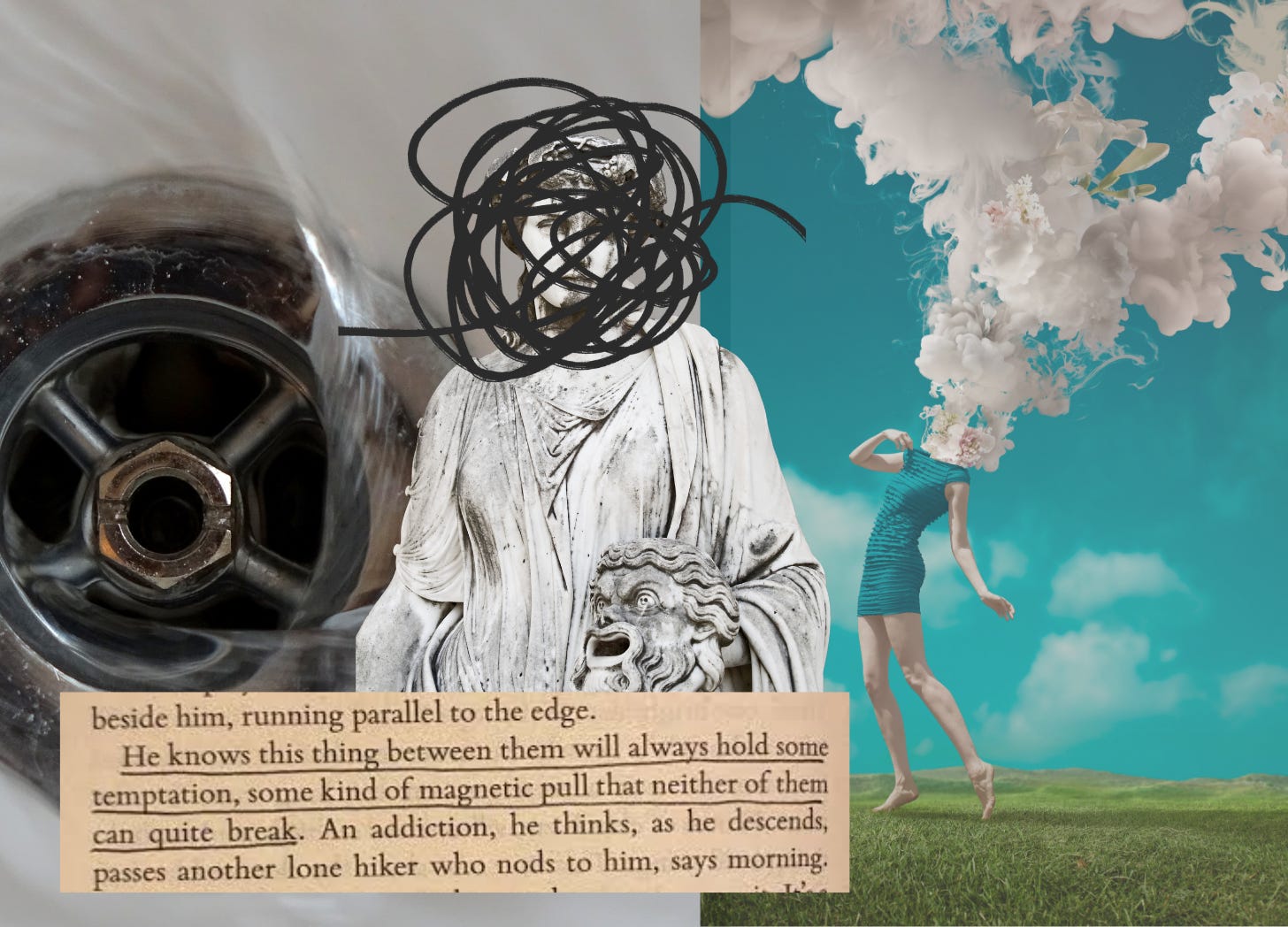
Talking At Night by Claire Daverly. I could scream about this book. I almost don’t want anybody else to read it because I don’t want them to ruin it for me – it feels like it was mine, entirely. I wish I had written this book. It had every trope I adore in writing – a will-they-won’t-they relationship, straight A girl and sad overlooked boy, shocking trauma, a character with OCD. I read this book in two days. It was described as similar to Normal People, and while the premise is indeed similar, it’s also very different. Many of the more negative reviews compare it to Normal People, unfairly. There is a scene that I read and I cannot stop thinking about. A simple scene, between teenagers. One warming up the others hands in the cold. It was so sweet I could taste it. (Note: the quote in the graphic above is from this book).
Heart the Lover by Lily King. I thought it would be about a love triangle, based on the description, but it really wasn’t. It was about different forms of love, and how they change over time, and how so much of what happens between people occurs off-page. The prose was fantastic in this, as well. And the ending absolutely gutted me.
I need to know who this guy saying OCD is curable is :))))) great piece! Not a fan of sci fi but will def give a try to normal people :)
"I know I will get stuck in a cycle of criticism again – it’s one of the hallmarks of my OCD, which despite what some guy I saw on TikTok says, is not a curable disease (see: treatable, not curable)." Thanks for writing, solidarity! <3